

How Dark Energy Serves the Second Law (LE-GR)
The Second Law tolerates symmetry only temporarily.
Orbital motion, resonance, and long-lived gravitational structures are metastable permissions, not exemptions. The Second Law allows them to persist for billions of years, but no symmetry is ultimately protected.Gravitational radiation is entropy production as a last resort.
When matter is locked into clean, low-dissipation orbital symmetries, gravity slowly bleeds energy through gravitational waves—breaking symmetry, collapsing phase space, and forcing irreversible evolution.Structure is not the enemy of entropy—it is the mechanism.
Stars, galaxies, and black holes are not violations of the Second Law; they are tools the Second Law uses to extract and dissipate free energy when simpler channels are exhausted.Dark energy ensures dissipation does not stall.
When local structure formation saturates, cosmological expansion re-opens phase space globally, preventing gravitational order from becoming terminal or cyclic.Mergers are not accidents—they are thermodynamic mandates.
Galaxy mergers, star accretion, and black-hole coalescence systematically reduce independent degrees of freedom, compressing histories and increasing irreversible constraint.All admissible futures funnel toward fewer structures.
LE-GR suggests gravity implicitly guarantees that bound systems do not persist indefinitely; all structure is eventually driven toward collapse, merger, or evaporation.Vacuum expansion is the final entropy sink.
The ultimate admissible future is not maximal disorder, but maximal phase-space availability: a cold, dilute vacuum where all structured degrees of freedom have been spent.There is only one terminal outcome.
In LE-GR, the universe does not branch endlessly. There is a single admissible end-state: all structure exhausted, all gradients dissipated, and vacuum expansion dominant.The Big Bang was the first Second-Law shock.
It forcibly opened phase space and created gradients. Dark energy represents the closing act: ensuring no residual structure blocks the completion of that process.Gravity is not passive—it is directive.
Dark energy implicates gravity as an active participant in entropy maximization, explicitly steering matter through structure, collapse, and expansion to complete dissipation.This explanation is minimal, not mystical.
LE-GR does not invoke new substances, fine-tuning, or anthropic selection—only the sovereignty of the Second Law applied consistently to cosmology.This does not forbid or endorse theological or teleogical implications.
The Big Bang was the first Second Law shock in cosmology, and LE-GR would be 10x Big Bangs in shock value.
All claims are falsifiable.
LE-GR predicts specific relationships between structure lifetime, gravitational radiation, merger statistics, and late-time expansion that can be observationally constrained.The Singularity as the Sole Admissible Future (LE-GR)
The singularity is not an anomaly; it is the thermodynamic terminus.
In LE-GR, a singularity represents the endpoint reached after all entropy production via structure has been exhausted. It is not a failure of physics, but the final admissible state once no further constrained dissipation remains.Structure exists to delay, not prevent, the singularity.
Galaxies, stars, and black holes are entropy-producing intermediaries. They prolong dissipation by creating gradients and constraints, but once those channels saturate, collapse is inevitable.The horizon encodes maximal entropy for a bounded region.
Black-hole horizons saturate entropy bounds, signaling that no further internal phase-space expansion is possible. This implies active coupling between structured spacetime and the vacuum beyond the horizon.Maximum horizon entropy implies vacuum participation.
When entropy is maximized at a horizon, remaining dissipation must occur through vacuum expansion. This establishes a direct thermodynamic link between black holes, dark energy, and cosmological expansion.Dark energy is the continuation of dissipation after structure fails.
Once matter-based entropy production stalls, expansion re-opens phase space globally. Vacuum expansion is not optional; it is required to complete the Second Law’s mandate.The universe has a single admissible late-time future.
LE-GR admits no cyclic or eternal steady states. All paths converge toward exhausted structure, horizon saturation, and vacuum-dominated expansion.Gravitational waves are the bookkeeping signal of this process.
The slow decay of orbital systems, mergers, and horizon dynamics necessarily produces ultra-low-frequency gravitational radiation.Nanohertz gravitational waves are expected.
LE-GR predicts stochastic backgrounds in the nHz regime arising from:horizon–vacuum coupling at cosmological scales.
PTA systems are directly relevant tests.
Pulsar Timing Arrays (PTAs) and next-generation gravitational-wave detectors probe precisely the frequencies where LE-GR predicts residual dissipation should appear.This provides a falsifiable observational pathway.
Deviations in gravitational-wave backgrounds, merger statistics, or horizon entropy scaling would directly constrain—or refute—the LE-GR interpretation.The singularity is the Second Law completed.
It marks the moment when all constrained degrees of freedom have been spent, all structure paid for, and only unrestricted phase-space expansion remains.Penrose: The Almost–LE-GR Moment
Weyl curvature as entropy geometry.
Penrose proposed that gravitational entropy is encoded in the Weyl curvature tensor. In simple terms:Early universe → low Weyl curvature → low gravitational entropy.
Clumpy universe → high Weyl curvature → high gravitational entropy.
This was an attempt to give gravity a thermodynamic arrow directly in geometry.
The problem Weyl curvature was trying to solve.
Penrose sought to explain:Why the Big Bang had extraordinarily low entropy.
Why gravitational clumping increases entropy.
Why the early universe was so geometrically smooth.
His Weyl curvature hypothesis tried to encode entropy directly into spacetime curvature.
Where it falls short (LE-GR view).
Geometry alone cannot encode entropy.
Entropy is fundamentally combinatorial:It counts accessible micro-configurations.
It reflects phase-space expansion.
It tracks forbidden futures.
Weyl curvature may correlate with entropy, but it does not generate or count combinatorial possibilities.Dissipation alone serves the purpose of expansion of phase space, so low-entropy beginning is not a mystery in LE-GR, it is expected.
Penrose’s Objective Reduction (OR).
Penrose proposed that gravity causes quantum wavefunction collapse.
His reasoning:Superposed geometries imply ambiguous spacetime curvature.
Nature does not tolerate indefinite geometric ambiguity.
Above a threshold, collapse occurs.
Similarity to LE-GR.
Both Penrose and LE-GR:Reject strict global unitarity.
Treat gravity and quantum mechanics as deeply intertwined.
Take irreversibility seriously.
Suspect collapse is real, not merely epistemic.
Critical difference: direction of causation.
Penrose:
Gravity triggers collapse because geometry cannot sustain superposition.
LE-GR:
Collapse is the Second Law in action; gravity enforces its irreversible consequences.
In Penrose, gravity causes non-unitarity.
In LE-GR, non-unitarity (Second Law sovereignty) causes gravity.Penrose’s non-unitary stance.
He openly questioned:The completeness of quantum mechanics.
The universality of unitarity.
Whether objective reduction is required.
This already places him outside strict Copenhagen or Many-Worlds orthodoxy.
Where LE-GR goes further.
Penrose introduces non-unitarity as a correction.
LE-GR elevates non-unitarity to a fundamental axiom:The Second Law is sovereign.
Irreversibility is primary.
Geometry must submit to entropy expansion.
The ontological escalation.
Penrose tried to encode entropy geometrically.
LE-GR encodes geometry thermodynamically / combinatorially.Why Penrose almost arrived.
He identified:Low initial entropy as central.
Gravitational degrees of freedom as thermodynamic.
Non-unitarity as physically necessary.
But he stopped short of declaring the Second Law as the governing principle from which gravity itself emerges.
How the LE-GR Field Equation Would Look
1. Start from GR 1.0
Einstein’s equation:
Gμν +Λgμν =8πG Tμν
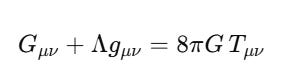
Where:
Gμν = spacetime curvature
Tμν = stress–energy tensor
Λ= cosmological constant
GR assumes:
Geometry is sourced by local energy–momentum.
Time symmetry holds at the equation level.
Stress–energy is the fundamental source.
2. LE-GR Ontological Shift
LE-GR replaces “energy as source” with:
Latent constraint as source.
Define:
Λlatentμν
as a tensor encoding:
Accumulated forbidden futures
Irreversible phase-space compression
Latent degrees of freedom not locally realized
Non-unitary history dependence
3. The LE-GR Equation (Conceptual Form)
The field equation becomes:
Gμν=8πG Λlatentμν
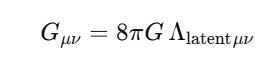
Where:
Λlatentμν replaces the conventional stress–energy tensor.
Ordinary matter is now a manifestation of latent constraint structure.
Dark energy is not a constant — it is residual global latent entropy.
Important:
In regimes where stress–energy bookkeeping works (low dissipative, quasi-reversible),Λlatentμν⟶Tμν
So GR 1.0 is inherited as an equilibrium limit.
4. Equation of State Inheritance
GR 1.0 already contains:
∇μTμν=0
which expresses local conservation.
LE-GR inherits this structural consistency but reframes it:
∇μΛlatentμν = irreversible source term
This source term encodes:
Horizon formation
Collapse
Gravitational radiation
Singular structure formation
So the relation between states remains tensorial and covariant.
But:
The mapping between states is non-unitary.
5. Non-Unitary Evolution
In LE-GR:
State evolution cannot be globally invertible.
Information is not conserved in a reversible Hilbert sense.
Phase space expands irreversibly.
Therefore:
U(t1→t2) ≠ U−1(t2→t1)
Entropy is not computable if:
The Second Law is sovereign.
New degrees of freedom become accessible.
Phase space itself expands.
This makes the theory inherently:
Non-unitary
Non-globally computable
History dependent
6. What Remains from GR 1.0
LE-GR keeps:
Lorentz invariance (locally).
Light cones.
Differential geometry.
Covariance.
It modifies:
What sources curvature.
Whether stress–energy is fundamental.
Whether time symmetry is fundamental.
7. The Axiomatic Difference
GR 1.0 implicit axioms:
Lorentz invariance.
Equivalence principle.
Energy–momentum conservation.
Time symmetry at fundamental level.
LE-GR explicit axioms:
The Second Law is sovereign.
Irreversibility is fundamental.
Phase space can expand.
Geometry encodes accumulated constraint.
Unitarity is not globally valid.
8. Mathematical Rigor Clarification
No theory has the right to claim mathematical rigor unless:
Its axioms are explicitly listed.
Its necessary consequences are derived from those axioms.
Its closure conditions are stated.
If a framework assumes:
Global unitarity,
Fixed Hilbert space,
Time symmetry,
without declaring them as axioms,
it is no more rigorous — only implicit.
LE-GR must therefore:
Declare irreversibility as an axiom.
Derive geometric consequences from it.
Reduce to GR 1.0 in appropriate limits.
Only then is it competitive.
Why Quantum Gravity Is a Law-2 Violation (LE-GR)
In LE-GR, gravity is the enforcement of causality and the prohibition of futures.
It encodes irreversible pruning of phase space. It is not a fluctuating field — it is the geometric record of forbidden transitions.Quantum superposition of gravity would imply superposed causal structure.
If gravity were a quantum field, light cones and causal order could exist in superposition. That makes causality ambiguous.Ambiguous causality violates a sovereign Second Law.
If the prohibition of futures can itself be in superposition, then irreversibility is not fundamental. Therefore gravity cannot be fundamentally quantum without demoting the Second Law from sovereignty.A bunch of extraneous GR possibilities are prohibited in LE-GR
White holes
Negative mass
Turning off gravity
Artificial gravity
Blocking gravity
Reversing gravity
All are Law-2 violations. 😏