

Why the hidden axiom of Unitarity doomed entropy–gravity theories
Second-Law sovereignty vs unitarity (incompatibility)
If the Second Law is sovereign, then history is irreversible in principle, not merely in practice.
Unitarity, by contrast, asserts that evolution is fundamentally reversible and information-preserving.
These two claims cannot both be ontologically true.
Unitarity: every state can be inverted; no futures are ever truly forbidden.
Second Law (sovereign): some transitions are impossible; phase space is pruned; history is single.
Any theory that keeps unitarity as a sacred axiom must therefore treat entropy as:
emergent
epistemic
or illusory
This move quietly demotes the Second Law and prevents gravity from acting as an enforcer of irreversibility.
Ontological contrast
Unitary ontology → Second-Law ontology (LE-GR)
Reversibility
→ IrreversibilityState
→ ProcessBeing
→ BecomingNoun
→ VerbEntropy is an illusion
→ Entropy is realEntropy = disorder
→ Entropy = activated degrees of freedom (DOF)Order is suspicious
→ Order is ordained (but energetically costly)First Law primary
→ Second Law sovereignInformation conserved
→ Information destroyedComputer = Turing machine
→ Computer = Second-Law (Law-2) machineDifferentiability
→ Stepwise exclusionContinuity
→ DiscretenessGeometry
→ CombinatoricsFixed phase space
→ Expanding phase spaceTime-reversal symmetry
→ Arrow of time fundamentalMeasurement is epistemic
→ Measurement is onticSecond Law is statistical
→ Second Law is enforcement
Ontological contrast (unitarity vs Second-Law sovereignty)
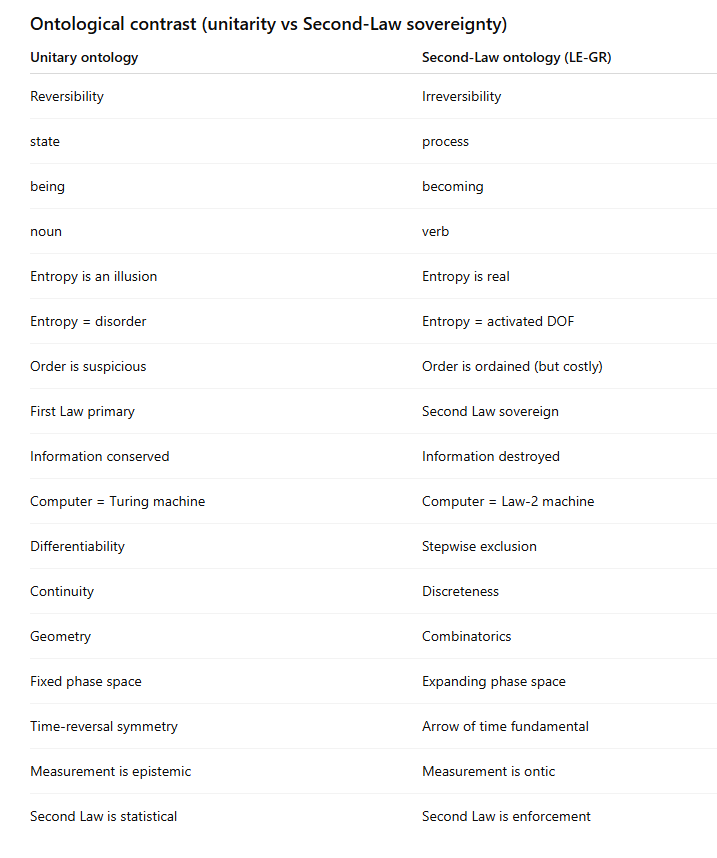
Why this axiom blocks entropy-based gravity
Once unitarity is assumed, gravity cannot be the enforcer of the Second Law, because:
gravity would have to destroy information
forbid futures
and make history single.
But unitarity forbids all three.
So entropy-gravity programs are forced into evasions:
horizons as “information hiding” rather than destruction
microstates as eternal bookkeeping
entropy as observer-dependent
gravity as emergent but not authoritative
They look for something else to “do gravity”:
a particle (graviton)
a horizon
a quantum soup
an entanglement metric
an effective field
But all of these preserve reversibility underneath.
The result is gravity without teeth.
What LE-GR does differently
LE-GR drops unitarity at the ontological level.
Not as a technical tweak, but as a foundational correction.
This immediately allows:
real information loss
true exclusion of futures
irreversible history
gravity as a phase-space authority
Gravity no longer needs:
extra particles
hidden dimensions
fine-tuned cancellations
or computational miracles
It enforces the Second Law because that is what it is.
Why others almost got there (but didn’t)
Jacobson saw thermodynamics in horizons but kept reversibility elsewhere.
Verlinde invoked entropy but retained microstate conservation.
Penrose suspected non-unitarity but confined it to collapse.
All three sensed the crack.
None crossed it.
LE-GR does.
Summary
Any theory that treats unitarity as sacred cannot make the Second Law sovereign; any theory that makes the Second Law sovereign must abandon unitarity.
Why Reverse-Engineering Thermodynamic Gravity from Entanglement Is Nearly Impossible
Entanglement describes correlations, not constraints.
Quantum entanglement encodes how remaining degrees of freedom are related within a fixed Hilbert space; it does not encode which degrees of freedom have been irreversibly removed from physical accessibility.Physical structure arises from energy gaps, not correlations.
Macroscopic objects exist because large energy gaps suppress internal transitions, forcing collective motion (e.g., center-of-mass momentum). These gaps represent forbidden transitions, not entangled ones.Energy gaps are defined by absence, not observables.
An energy gap is not a state, excitation, or measurable quantity — it is the nonexistence of allowed transitions. Standard quantum formalisms have no operator that directly represents “states that no longer exist.”Modes may be entangled, but gaps separate which modes survive.
Thermal, vibrational, and electronic modes can be entangled within a constrained structure, but the decisive distinction between bulk momentum modes and internal modes is enforced by energetic exclusion, not correlation strength.Energy is both the agent of constraint and the thing constrained.
Free energy flux drives irreversible processes that delete futures (forming bonds, rigidity, structure), after which energy itself becomes confined to the narrowed phase space those constraints create.Energy is defined only relative to allowed transitions.
Where transitions are forbidden, energy loses operational meaning; it cannot be cleanly localized, measured, or assigned independent of the constraint history that defines what transitions remain possible.Local gravitational energy is therefore ill-defined.
Gravity responds to accumulated constraint, which is nonlocal and history-dependent. This is why gravitational energy resists localization and why curvature persists without ongoing dynamics.Recovering constraint requires the full irreversible history.
To infer present-day gravitational structure from microscopic descriptions, one would need the complete sequence of energy dissipation and transition suppression that produced current constraints — information that is irreversibly destroyed.Multiple histories collapse to the same constrained present.
Many distinct micro-histories lead to identical macroscopic structures, making inverse reconstruction fundamentally underdetermined even in principle.Entanglement can at best track constraint indirectly.
As constraints accumulate, the remaining degrees of freedom often become more strongly correlated, so entanglement may correlate with geometry — but it cannot identify which possibilities were eliminated.Empirical access is blocked at every level.
Forbidden transitions cannot be observed, energy gaps cannot be mapped globally, and correlations alone cannot distinguish reversible structure from irreversible constraint.Information conservation becomes a fallback assumption.
In the absence of a language for deleted possibilities, frameworks often assume information is preserved “somewhere,” hoping correlations encode what has in fact been physically erased.
Why “Gravitating-Only” Particles Are Second-Law Violations (LE-GR)
Claim (LE-GR): A purely gravitating particle — one that sources curvature but has no non-gravitational couplings, no dissipation channel, and no participation in entropy production — is not merely “hard to detect.” It is ontologically suspect: a Second-Law violation under Second-Law sovereignty.
The core contradiction: curvature without an entropy economy
In LE-GR, gravity is not an additive stuff; it is constraint bookkeeping: the enforcement mechanism that prices forbidden futures and mediates the conversion between realized entropy and latent entropy (constraint/curvature).
A gravitating-only particle would create constraint (curvature) while being thermodynamically mute: it cannot thermalize, catalyze chemistry, radiate, bind, decay, or couple into any irreversible channel.
That means it can deepen wells and bias trajectories without ever paying dissipation, and without enabling the very “structure → entropy” pipeline gravity exists to orchestrate.
“Violating the futures contract” intuition
Gravity’s “contract” in LE-GR is simple:
If gravity forbids futures (creates constraint), it must be downstream of, or coupled to, an entropy-carrying process that can eventually liquidate that constraint.
A gravitating-only particle breaks this contract:
It borrows against the space of allowed futures (adds constraint)…
…but never participates in the liquidation (realized entropy) that closes the books.
It becomes a one-way accumulator of “credit”: constraint issued without a dissipative repayment channel.
That is exactly the smell you’ve been describing: curvature that doesn’t “belong” to the Second Law.
“Constraint without participation” is a forbidden ontological object
Reasons this is incompatible with Second-Law sovereignty (LE-GR):
No entropy export: If it never radiates, never collides, never decays, it cannot export irreversibility. It is thermodynamically inert while being gravitationally active.
No structural pathway: Gravity’s role is to catalyze higher-order structure formation (orbits → mergers → collapse → terminal relaxation). A gravitating-only species cannot join this ladder. It is “mass” without the thermodynamic vocation of mass.
No equilibration: Every massive sector must, in the long run, admit equilibration paths. A strictly gravity-only sector is an equilibration dead end.
No MEPP compatibility: If the universe “chooses” dissipation pathways (MEPP flavor), a gravitating-only sector is a parasitic constraint contribution that does not increase the system’s entropy-processing capacity. It raises curvature bookkeeping while refusing the dissipative job curvature bookkeeping exists to serve.
No local causation story: In LE-GR, “gravity” is inseparable from histories of constraint creation and liquidation. A gravitating-only particle makes gravity look like an additive commodity again — exactly the category error LE-GR rejects.
Therefore: “gravity-only matter” is not just empirically unsupported; it is ontologically malformed under LE-GR.
Consequence: Other Forces Must Be Reinterpreted as Second-Law Servants
Once gravitating-only objects are prohibited, it implies something powerful:
The other interactions cannot be optional decorations. They are the thermodynamic plumbing that makes gravity lawful.
So LE-GR forces a re-reading of forces as entropy roles:
Strong force — durability of localized order
Creates long-lived, high-binding structures (nuclei) that can persist and compound.
Supplies stable “atoms of constraint” that gravity can stack into higher-order structures.
Thermodynamic role: makes mass durable enough to matter.
Electromagnetism — the chemistry engine / entropy interface
Enables atoms, molecules, solids, photons, radiative cooling, conduction, and essentially all macroscopic dissipation channels.
Thermodynamic role: turns constraint into rich, irreversible pathways (chemistry, radiation, transport).
Weak force — unstalls history
Enables identity change (p→n, β-decay), breaks symmetry traps, and dumps entropy through escaping neutrinos.
Thermodynamic role: guarantees irreversible exits so systems do not freeze in metastable cul-de-sacs.
LE-GR moral: Forces are not symmetric “interactions.” They are differentiated Second-Law roles. Gravity enforces the global ledger; the other forces generate and route the real dissipation that makes the ledger meaningful.
Dark Energy Ex Nihilo Is Strongly Suspected to Be a Second-Law Violation
(pending the clean definition of dissipation under sovereignty)
If dark energy is literally a cost-free vacuum source that drives expansion indefinitely, it resembles entropy creation without liquidation: expansion of macroscopic possibility space with no irreversible bill being paid.
Under a sovereign Second Law, expansion is not “just geometry.” It is a process that must correspond to realized entropy production or constraint liquidation somewhere.
Therefore Λ as an eternal ex-nihilo push is strongly suspected to be a Law-2 violation — not because acceleration is impossible, but because free acceleration is.
LE-GR’s alternative: expansion is finite, sourced, and regime-dependent — the terminal dissipation channel of latent-entropy curvature debt (constraint) relaxing toward vacuum when other entropy-carrying modes saturate, and dissipation through structure is no longer possible.
Massive Weak-Only and Barely-Interacting DM Candidates Are Suspicious
These aren’t as cleanly “forbidden” as gravity-only matter, but they inherit the same smell: mass without thermodynamic participation.
Massive weak-only particles (or “almost only weak”)
The weak interaction is primarily an irreversible exit channel, not a structure builder.
If a particle is massive and durable yet couples only weakly, it risks becoming “constraint that won’t cash out” — long-lived curvature contribution with minimal dissipation integration.
LE-GR suspicion: heavy, long-lived weak-sector matter tends toward the same futures-contract violation, just slower and more hidden.
“Barely interacting” DM (hidden sectors, feeble portals, ULDM with optional couplings → 0)
The more a DM candidate retreats into non-interaction to survive constraints, the more it starts resembling bookkeeping, not matter.
If it cannot:
thermalize
radiate
catalyze structure
or participate in irreversible channels,
then it is carrying gravitational significance without contributing to the entropy economy.LE-GR suspicion: “dark matter” that is forced to be increasingly invisible begins to look like misidentified latent-entropy curvature, not missing particles.
Conjecture: Dark-energy expansion as latent-entropy relaxation to the ground state
Core LE-GR claim: Latent-entropy curvature debt — created when gravity forbids futures and stores constraint — must ultimately relax.
When no further structural channels remain, relaxation proceeds into the vacuum as large-scale expansion.No ex nihilo component: Dark-energy–like expansion is not a new substance or field. It is the terminal dissipation channel of accumulated latent entropy once structure formation saturates / no longer possible.
Singularities as thermodynamic endpoints (not places)
Mathematical meaning: A singularity marks a breakdown of invertibility and branching in the equations — a non-extendable, non-invertible endpoint of evolution, not a physical surface.
LE-GR interpretation: Singularities signal that only one admissible future remains. They are thermodynamic terminals where alternative macrostates are fully prohibited.
Big Bang & black holes:
The Big Bang corresponds to an initial singular configuration with a single admissible mode.
Black-hole singularities represent local endpoints where constraint saturates and no further internal structure is admissible.
Vacuum relaxation as the final dissipation channel
When structure saturates: After mass localization, binding, fusion, mergers, and collapse exhaust admissible channels, vacuum expansion becomes the remaining path to satisfy the Second Law.
Finite, history-dependent expansion: Expansion reflects prior constraint accumulation; it is therefore finite and contingent on structure formation, not eternal or fundamental.
It is the final dissipative option for to satisfy the Second Law when dissipation through order / structure is not available.
Observational alignment (without Λ)
Timing: Cosmic acceleration appears after significant structure formation.
LE-GR predicts this ordering; ΛCDM does not explain why acceleration waits.Correlation: Acceleration strength should correlate with the integrated history of gravitational constraint (structure, mergers, black holes), not with an independent vacuum constant.
Weinberg no-go escape: Because expansion is not vacuum energy set by a constant, LE-GR avoids fine-tuning and provides an exit from the cosmological-constant problem.
Low-frequency gravitational relaxation (testable implication)
Prediction (conjectural): A portion of latent-entropy relaxation may occur via ultra-low-frequency gravitational radiation (nano-Hz and longer), sourced by large-scale relaxation of galactic and black-hole constraints.
Status: Whether galactic-scale latent entropy (often labeled “dark matter” phenomenology) contributes to this channel remains open.
Test: Future detectors sensitive to very long wavelengths should find stochastic or coherent backgrounds not attributable to compact binaries alone.
Black holes, Hawking radiation, and MEPP
MEPP framing: Black holes are dissipative structures that relax constraint according to maximum entropy production, not perfect equilibrium objects.
On Hawking radiation: Derivations rely on extrapolations beyond classical regimes.
LE-GR does not require microscopic evaporation to satisfy the Second Law; macroscopic relaxation channels (gravitational waves, vacuum expansion) suffice.Hawking radiation derivation smuggles infinities, which deserves extra scrutiny in Second Law Ontology. Physics has often got into trouble from extracting ontology from smuggled infinities.
Implication: Evaporation times inferred from semiclassical treatments may be unphysical if they assume regimes outside validity.
Gravitational waves from vacuum expansion is observable and thus falsifiable, unlike Hawking radiation.
What infinities are actually being smuggled in (Hawking radiation)?
Here are the concrete offenders, stated plainly.
1. Trans-Planckian frequency infinity
In Hawking’s derivation, outgoing low-energy photons observed far from the black hole trace back to modes arbitrarily close to the event horizon.
When you follow those modes backward in time:
Their frequencies blueshift without bound
They exceed the Planck scale
They formally approach infinite frequency and energy
This is not a small technical detail. It means the derivation assumes:
Quantum field theory remains valid at arbitrarily small length scales and arbitrarily high energies.
Second Law Ontology objection:
Infinite-frequency modes imply infinite local degrees of freedom
Entropy accounting becomes undefined
You are asserting physical meaning in a regime where the theory explicitly breaks down
This is the classic trans-Planckian problem, not a fringe critique.
2. Infinite vacuum mode density near the horizon
The derivation treats the vacuum as containing an unbounded continuum of modes arbitrarily close to the horizon.
Mathematically:
The density of states diverges
Mode counting becomes infinite
Regularization is imposed after physical interpretation
Ontological problem:
Entropy requires countable accessible degrees of freedom
An infinite reservoir of modes acts like a free entropy cheat code
The Second Law becomes satisfied by assumption, not mechanism
This is exactly the kind of move your ontology is allergic to—and rightly so.
3. Infinite time extrapolation
Hawking evaporation times are computed assuming:
The semiclassical description remains valid
Over timescales vastly exceeding any known physical relaxation time
With no structural or cosmological backreaction invalidating the setup
In effect:
A local approximation is extrapolated to cosmological times
Without new entropy channels opening
Without phase changes in spacetime structure
Second Law framing:
Irreversible systems typically open new macroscopic dissipation channels
Assuming a single microscopic channel dominates forever is historically wrong
This is the same error made in early heat-death and ether models.
4. Renormalization hides, rather than resolves, the infinities
The infinities are not deleted by physics; they are subtracted mathematically.
That’s acceptable for calculations—but dangerous for ontology.
History lesson (important):
Renormalization works when infinities are bookkeeping artifacts
It fails when infinities are standing in for missing physics
Second Law Ontology treats renormalized infinities as:
signals that entropy accounting is incomplete, not complete.
Why LE-GR doesn’t need Hawking radiation
LE-GR satisfies the Second Law without invoking microscopic evaporation, because:
Black holes are treated as macroscopic dissipative structures
Constraint relaxes via:
gravitational waves
vacuum expansion
large-scale geometric reconfiguration
These channels are:
finite
observable
falsifiable
Second-Law aligned
No infinite frequencies required.
No infinite mode density required.
No extrapolation beyond validity required.